

Multiplication methods help children move from practical counting strategies to formal written multiplication. In primary maths, pupils are taught a progression of methods including repeated addition, arrays, partitioning, the grid method, short multiplication and long multiplication.
This guide explains the main multiplication methods used in KS1 and KS2, with examples to show how each method works and how children’s understanding develops over time.
👉 Explore ready-to-teach multiplication lessons
Multiplication Methods in Primary School
Children are introduced to multiplication gradually. They begin by making equal groups and using practical equipment before moving on to written multiplication methods.
| Stage | Multiplication method | What children learn |
|---|---|---|
| KS1 | Equal groups and arrays | Children understand multiplication as groups of the same size. |
| Year 2 | Repeated addition | Children link multiplication to adding the same number again and again. |
| Year 3 | Partitioning | Children split numbers into tens and ones to multiply more efficiently. |
| Year 3/4 | Grid method | Children use place value to organise multiplication clearly. |
| Year 4 | Expanded multiplication | Children record more formal steps before moving to compact written methods. |
| Year 4/5 | Short multiplication | Children multiply larger numbers by a one-digit number. |
| Year 5/6 | Long multiplication | Children multiply larger numbers by two-digit numbers. |
Multiplication Methods Covered in This Guide
- Multiplication using concrete objects
- Multiplication using pictorial representations
- Repeated addition
- Using number facts
- Partitioning
- The grid method
- Expanded multiplication
- Short multiplication
- Long multiplication
What are times tables?
Times tables are lists of multiples of a number. For example, 2, 4, 6, 8 and 10 are all multiples of 2. They are part of the two times table.
Knowing times table facts helps children use multiplication methods more confidently. For example, if children know that 6 x 4 = 24, they can use this fact when solving larger calculations such as 60 x 4 or 16 x 4.
Useful Multiplication Vocabulary
Children may hear lots of different vocabulary linked to multiplication. Useful words and phrases include:
- multiply
- multiplied by
- groups of
- lots of
- sets of
- array
- repeated addition
- product
- times table
- multiple
- factor
What are times table facts?
A times table fact is the answer to a multiplication number sentence. Each multiplication fact is linked to other related facts. For example, if children know that 2 x 4 = 8, they also know:
- 4 x 2 = 8
- 8 ÷ 4 = 2
- 8 ÷ 2 = 4
These related facts help children make connections between multiplication and division.
How do children learn multiplication?
Children learn multiplication by moving through a clear progression. They start by using practical objects, then pictures, then informal written methods, before moving on to formal written multiplication methods such as short multiplication and long multiplication.
Multiplication using concrete objects
Concrete objects help children see what multiplication means. Counters, cubes, buttons or classroom objects can be arranged into equal groups so children can count the total.

Using objects gives children a strong understanding of multiplication before they are expected to record calculations formally.
Multiplication using pictorial representations
Once children understand multiplication practically, they can use pictures or symbols to represent equal groups.

Pictorial representations are useful because they bridge the gap between practical equipment and written multiplication methods.
Repeated addition
Repeated addition is one of the earliest multiplication methods children learn. It shows that multiplication means adding equal groups.

Repeated addition helps children see why multiplication is a quicker way of adding equal groups.
Using number facts
Children can also use known number facts to solve multiplication problems. This might include times table facts, doubles, near doubles, or known multiples of 10.
For example, to solve 9 x 8, children could use 10 x 8 and subtract one group of 8:
10 x 8 = 80
80 - 8 = 72
So, 9 x 8 = 72.
They could also use doubling:
9 x 4 = 36
Double 36 = 72
Using known facts helps children become more flexible and efficient mathematicians.
Written Multiplication Methods
Written multiplication methods help children record their thinking when multiplying larger numbers. These methods usually build from informal strategies, such as partitioning, towards formal written methods, such as short multiplication and long multiplication.
Multiplication using partitioning
Partitioning means splitting a number into parts. Children often split numbers into tens and ones, or hundreds, tens and ones, before multiplying each part.
Example: 73 x 6
To solve 73 x 6, partition 73 into 70 and 3:
70 x 6 = 420
3 x 6 = 18
420 + 18 = 438
So, 73 x 6 = 438.

Example: 124 x 4
To solve 124 x 4, partition 124 into 100, 20 and 4:
100 x 4 = 400
20 x 4 = 80
4 x 4 = 16
400 + 80 + 16 = 496
So, 124 x 4 = 496.

The grid method for multiplication
The grid method is a written multiplication method that builds on partitioning. It helps children organise each part of the calculation clearly.
For example, to solve 66 x 8, children partition 66 into 60 and 6, then multiply each part by 8:
60 x 8 = 480
6 x 8 = 48
480 + 48 = 528
So, 66 x 8 = 528.

Informal partitioning multiplication
Informal partitioning is a more compact way of recording multiplication using partitioning. It requires children to have a secure understanding of place value because fewer steps are written down.

Expanded multiplication method
The expanded multiplication method is another step towards formal written multiplication. It shows each part of the calculation clearly before children move on to shorter methods.

What is the short multiplication method?
Short multiplication is a formal written multiplication method used to multiply a larger number by a one-digit number. Children usually learn short multiplication once they are confident with place value, times tables and partitioning.
In short multiplication, each digit is multiplied in order, starting with the ones. If an answer is greater than 9, children carry the extra tens, hundreds or thousands into the next column.
Short multiplication example
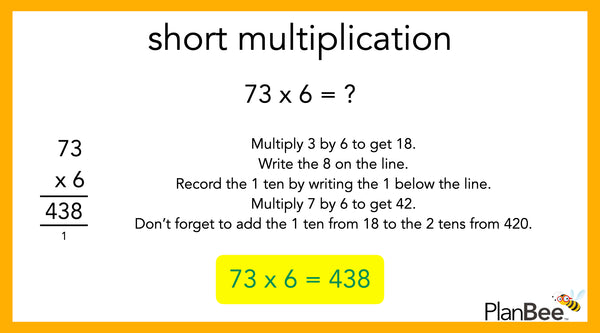
To solve 73 x 6:
- First multiply the ones: 3 x 6 = 18. Write 8 in the ones column and carry 1 ten.
- Then multiply the tens: 7 tens x 6 = 42 tens.
- Add the carried ten to make 43 tens.
- The answer is 438.
Short multiplication is efficient, but children need a strong understanding of the earlier multiplication methods before using it confidently.
What is the long multiplication method?
Long multiplication is a formal written method used when multiplying by a two-digit number or larger. It is often taught after children are secure with short multiplication.
Long multiplication involves multiplying by the ones digit first, then the tens digit, before adding the partial products together.
Long multiplication example
When solving a calculation such as 253 x 27, children multiply 253 by 7, then multiply 253 by 20, then add the two answers together.

Long multiplication is a useful method for larger calculations, but children need to understand place value carefully so they remember to multiply by tens, not just by the tens digit.
Free multiplication resources and times tables games
These free multiplication resources can help children practise times tables and become more confident with multiplication facts.

Times Table Grids and Multiplication Squares help children practise multiplication tables. The free pack includes completed, blank, mixed-up and missing-number multiplication grids.

Times Table Cubes help children practise the 2 times table to the 12 times table.

Times Table Booklet is a fun way to check and develop multiplication facts up to 12 x 12.

Times Table Chart provides a helpful reference point when children are learning multiplication facts up to 12 x 12.

Multiplication Wheels give children a fun way to practise times table knowledge and self-check their answers.

Multiplication Make a Square Game is a fun activity for practising multiplication skills.
Ready-to-teach multiplication and division lessons
PlanBee has a wide range of downloadable Maths lesson packs to support teaching multiplication and division across primary school. Each pack includes detailed planning, slideshow presentations, differentiated worksheets and supporting resources.
Browse our full collection of Multiplication and Division lesson packs to find ready-to-teach resources for your class.
👉 Explore ready-to-teach multiplication lessons
Multiplication Methods FAQs
What multiplication methods are taught in primary school?
Primary school children are usually taught practical grouping, arrays, repeated addition, partitioning, the grid method, expanded multiplication, short multiplication and long multiplication. These methods help children build understanding before moving on to formal written calculations.
What is the best multiplication method for children to use?
The best multiplication method depends on the child’s age, confidence and the numbers involved. Younger children need practical and pictorial methods, while older children may use short or long multiplication for larger calculations.
What is the short multiplication method?
Short multiplication is a formal written method used to multiply a larger number by a one-digit number. Children multiply each digit in turn, starting with the ones, and carry when needed.
What is the difference between short multiplication and long multiplication?
Short multiplication is used when multiplying by a one-digit number. Long multiplication is used when multiplying by a two-digit number or larger.
What is the grid method of multiplication?
The grid method is a written multiplication method that uses partitioning. Numbers are split into parts, multiplied separately, then added together to find the final answer.
Why are children taught different multiplication methods?
Children are taught different multiplication methods so they understand how multiplication works, not just how to follow a procedure. Each method builds on previous learning and prepares children for more formal written calculations.


